The Same Fire

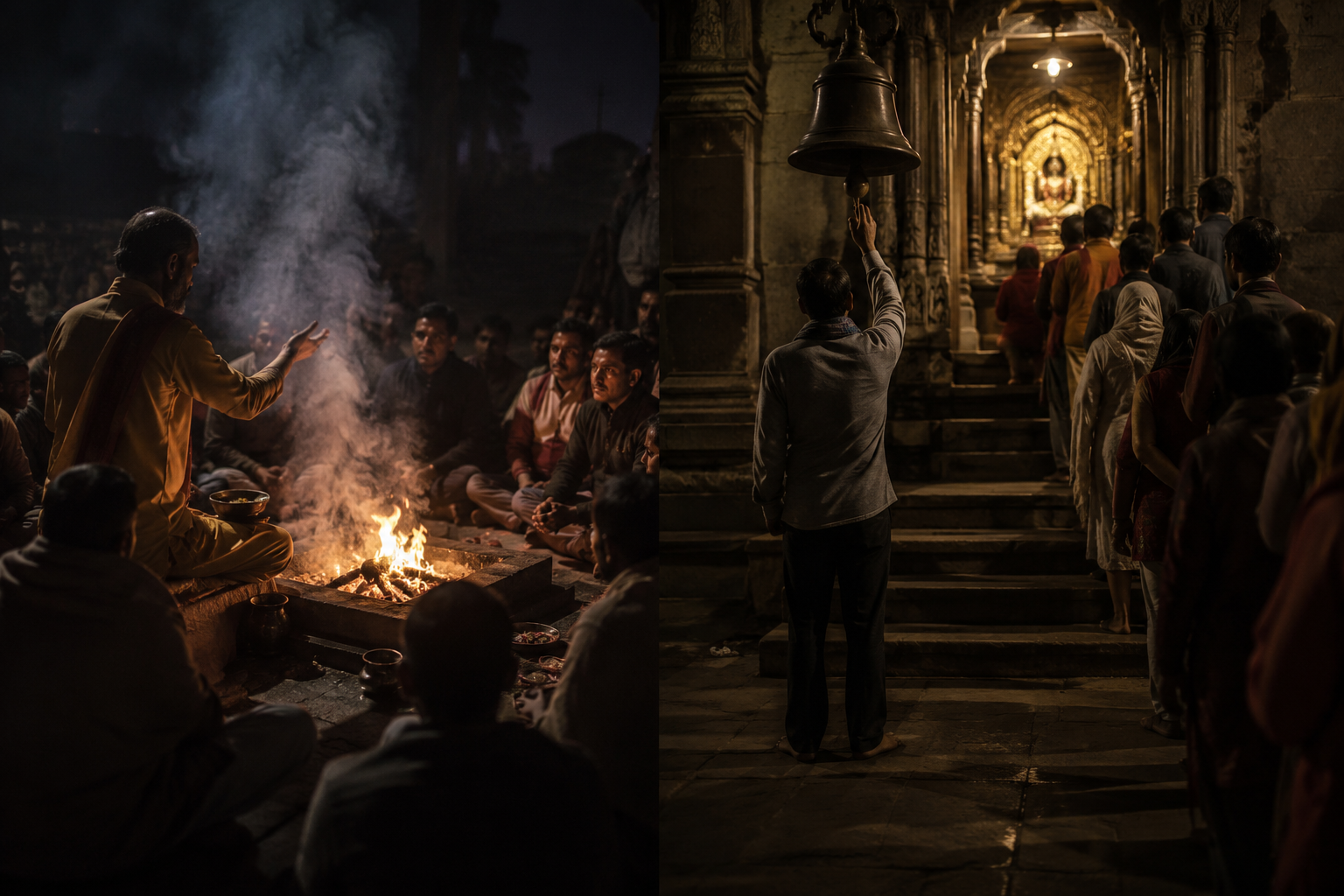
The priest's hands keep finding the same four shapes in the smoke — thumb to two fingers, flat to the chest, open toward the flame, and back again — a sequence that means something to him and nothing to the dozen of us sitting cross-legged around the fire pit, bare feet gone cold on the courtyard stone. Nobody asks what the shapes are called. We have learned the only thing we are required to learn: when the chanting lifts half a tone, a pinch of rice goes into the fire. That is the whole of our participation. The words above our heads could be asking for rain, for a good harvest, for the health of a stranger's child, for the end of the world, and we would nod at exactly the same pitch-change regardless — because the sound of the instruction and the meaning of the instruction come from two entirely different places, and only one of them was ever meant to reach us.
Go up the hill to the mandir and the same arrangement gets built in stone instead of smoke. There is an inner room where the god actually lives, and only the priest is permitted inside it; the rest of us stand at a marked distance and are handed back a coin of blessed sugar as proof that something occurred on our behalf, out of sight, in a language we were never issued. There is a bell at the threshold that everyone rings on the way in, and no one — not once, in all the mornings I have watched people ring it — has stopped to ask what the bell is actually for. You ring it the way you take off your shoes, the way you join the queue: an entry fee paid in gesture, never in understanding. The building itself has decided, floor by floor, exactly how close each of us is allowed to get to the thing we came to see.
Five hundred years before either of us was born, a weaver in Varanasi looked at exactly this arrangement and refused every part of it. Kabir would not enter the inner room, would not ring the bell, would not accept that reaching the sacred required a building's permission at all. He kept weaving, and prayed anyway, and lived as though the god the priests kept behind stone was not behind anything — was already in the loom, in the water a stranger drank, in the breath moving through a body that needed no threshold, no queue, no coin of sugar to prove it had been received. Same fire, if you like. Entirely opposite direction. The one tool every priesthood depends on is the demand that you accept without asking. Kabir picked up that same tool and turned it around, so that it demanded the opposite: question everything, including him.
That's the part worth saying plainly, once: the mechanism itself has no god in it, and no government either. It is only the machinery of unquestioned access — the gesture, the bell, the pitch-change that means drop the rice — and it will carry whatever gets loaded into it, in whatever direction the hand loading it chooses. A priesthood can point it at obedience. A weaver can point it at the exact opposite of obedience. The fire in the courtyard doesn't know the difference, and it was never going to tell us.
So the question was never whether to believe or disbelieve. It's this: whoever built the ceremony you're standing inside of right now — what did they load it to do?