The Boat You Build

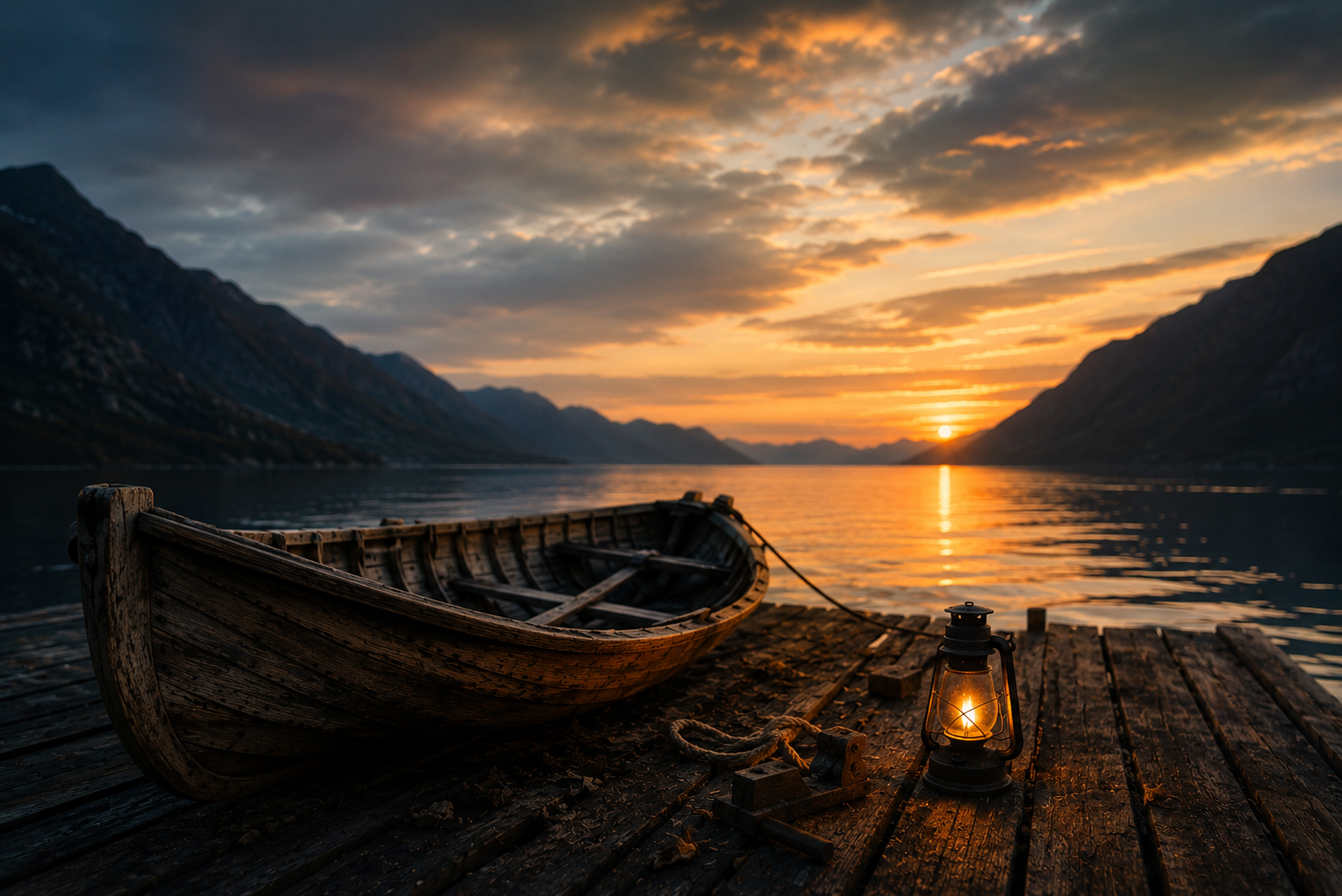
An evening with a Mark Knopfler song, and the difference between a life that was handed to you and one you built badly, then well, plank by plank.
There is a song I return to on the evenings when the valley has gone quiet and there isn't much left to do except sit with something warm and let a slow hour pass. It is Mark Knopfler's In the Sky, and I could not tell you, if pressed, what it is technically about. A sailor, perhaps. Someone coming home. But the specifics dissolve quickly, the way they do in the songs that matter, and what stays behind is a feeling — whole, and slightly too large for the four minutes it arrived in.
Early on there's an image I haven't been able to shake for weeks: a man who has crossed every sea he has ever crossed in a vessel of his own construction. Not one he bought. Not one handed to him by a father, a teacher, an institution. One he built, plank by plank, badly at first, and kept building until it held.
It is, I think, the plainest description I have found of what real work actually requires. Nobody hands you the vessel. You start, if you are lucky, with some rough material and worse instructions, and a great deal of water that does not care whether you are ready. The boat that eventually carries you anywhere is not the one you were promised. It is the one you assembled out of your own failures, over years nobody was watching.
I recognise the shape of this from a much smaller craft. The server that hums quietly in the next room. The site this essay will eventually sit on. The tools I've built and rebuilt because the ones that already existed never quite fit. None of it arrived finished. It got assembled the way the song describes — without a manual, mostly at night, corrected by whatever broke last.
Knopfler makes a quieter point a few lines on, about a life kept without formal notation, without lessons attended before the doing began. It would be easy to read this as a romance of the untrained, and I don't think that's what it is. What it actually describes is mastery that has absorbed its own rules so completely they've become invisible — indistinguishable from instinct. A person who has done a thing for thirty years does not consult the manual anymore. The manual is somewhere in the hands.
There's a stranger in the song too, hard and unconvinced, the kind of person the world reliably produces, who measures a life by what it has secured rather than what it has made. He isn't wrong, exactly. Boats sink. Years spent on an unfinished thing can look, from the shore, indistinguishable from years wasted. But the boat was never going to make sense to someone who only wants to know if it will get him somewhere on schedule. It was built for weather, not timetables.
Later, almost in passing, the song suggests that a life spent this way ends up quietly useful to other people — not because it announced itself as an example, but because someone, somewhere, heard it at the right hour and kept going a little longer than they otherwise might have. Most of what steadies us was never built to steady us. It just happened to be there when we needed steadying.
The title itself points at a place that isn't a place — not an altitude but a condition. I know it mostly from two unrelated things: a long descent on a bicycle where the front wheel is doing the thinking and you are simply agreeing with it, and the rare paragraph that arrives already whole and only needs to be typed out rather than built. Both states end. You cannot live at that height. But the ground is different once you've come down from it — heavier, somehow, in the right places.
What I take from the song, in the end, isn't a lesson about music but one about the shape a life is allowed to take. It doesn't need to be inherited to be legitimate. It doesn't need a manual, or the stranger's approval, or a schedule. It only needs to hold, in whatever water you actually sail — and to have been built, plank by plank, by the person now standing in it.
I notice, writing this on a site that is itself a small hand-built thing — no template borrowed wholesale, no schedule, very little urgency — that I have just spent nine paragraphs describing my own boat without once calling it that.