Count Them

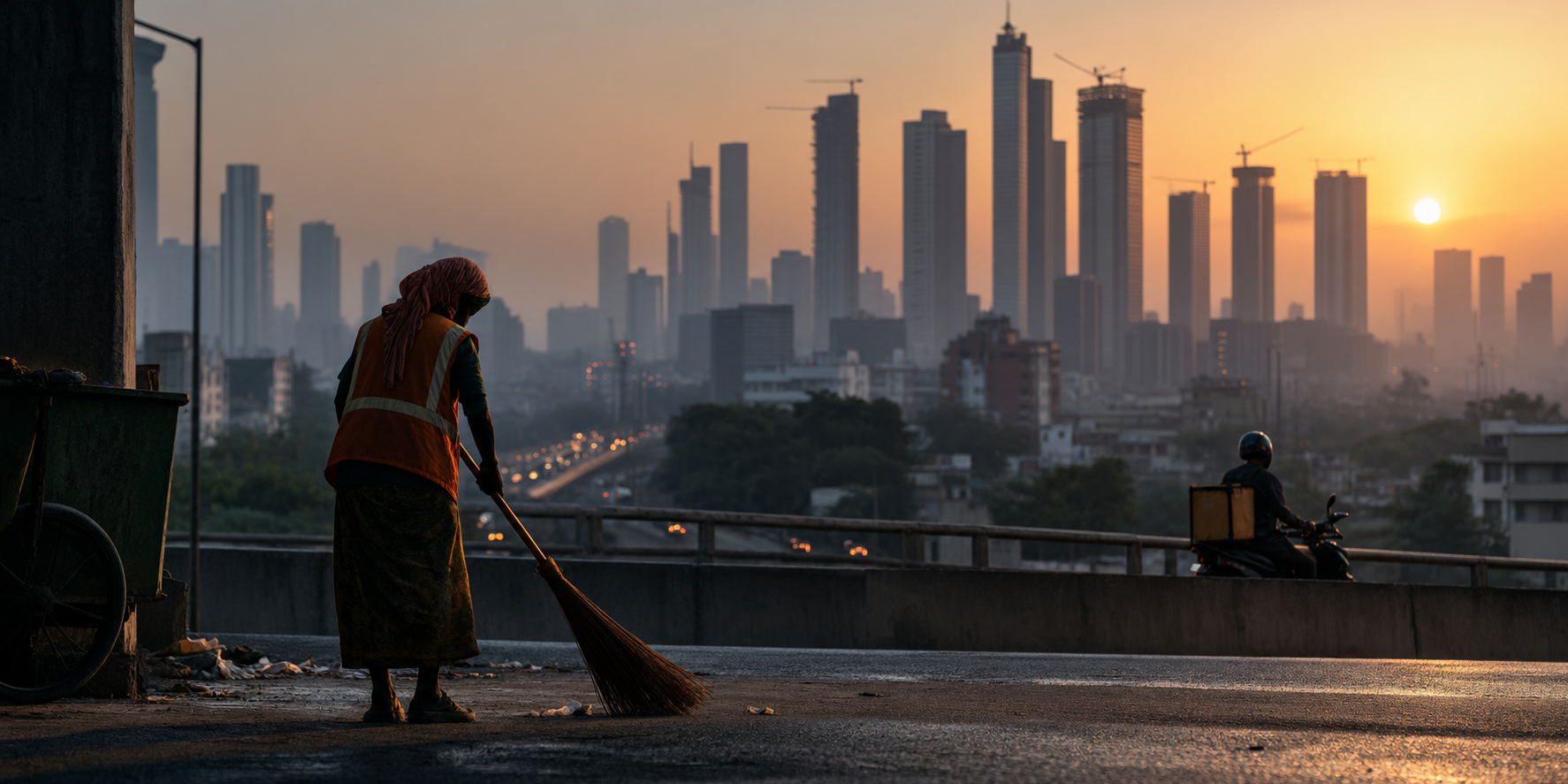
Start with the number, because the number does not care about your feelings. Fewer than sixty thousand people control three times the wealth of the poorer half of humanity. You could seat all of them in one stadium on a match day and leave the rest of the species standing outside the gates. The richest tenth of the planet holds three-quarters of everything there is to hold, and the poorer half holds two percent. Figures this grotesque tend to go abstract on contact, and that is the first thing worth resisting, because the bottom half is a woman sweeping a road before the city wakes, a man carrying sacks through a wholesale market, a labourer asleep in a tin shelter beside the tower he is helping to build, a rider waiting in the rain outside a restaurant for an order that has to reach someone's door in twenty minutes. Their labour is everywhere around us, and their lives are remarkably easy not to see.
The lead author of the report these numbers come from said that inequality stays silent until it becomes a scandal. I would like to know who it has been silent for. It has been loud in every kitchen where someone is doing sums at midnight, in every household that has quietly begun rationing things it once bought without thinking, in the life of anyone who knows that one illness or one lost job or one broken scooter can turn an ordinary month into a crisis. The silence belongs to people like me, who can read the figures, feel briefly appalled, and return to our evenings without anything in them demanding that we change. That is why I am writing this at all.
The people the city edits out
There is something peculiar about how a city hides the people who make it possible. We notice the road when it is broken, the rubbish when it goes uncollected, the traffic when it becomes unbearable, but the people who spend their mornings preventing those things from becoming visible are almost never in the picture. Someone swept the pavement before we woke. Someone emptied the bins and cleared the drains and carried away what we produced the night before, and we experience the result as the natural condition of the world, a clean street that seems to have arrived by itself.
The glass towers work the same way. We see the lobby and the silent lifts, but not the hands that carried the cement and tied the steel in the heat while the building was still a skeleton, because once the tower is finished their labour has been absorbed into the walls and become architecture. The food at the door feels like a property of an app. The hotel sheets feel like a property of the hotel. The cheap vegetables feel like a fact about the market, never a fact about the lives of the people who grew, picked, hauled and sold them. This is how inequality becomes bearable for those who benefit from it: the labour stays visible in the product and vanishes from the person, so that we receive the convenience while somebody else absorbs the inconvenience, and by the time the thing reaches us the human being has been removed from the transaction and only a price remains.
That may be why the statistics feel so bloodless. A percentage cannot look you in the eye or tell you it has been working since five, that its child is unwell, that rent falls due on Friday, or that it accepted the wage because no better one was on offer. We turn people into numbers because numbers are easier to live with, and this essay is an attempt, with the fewest numbers I could manage, to turn them back.
The letter they gave us
The economists have a letter for what is happening now. K. Two lines leave the same point on a chart, one climbing and one falling, and a whole society is made to live in the widening space between them. The phrase is clever because it describes the thing without accusing anyone of doing it, since nobody is responsible for a shape. But look at what the shape contains. In America, the richest tenth of earners now drive nearly half of all consumer spending, which means the economy's apparent health depends on the mood of a small and very comfortable minority, and every confident headline about the resilient consumer is a statement about them. The middle can be sinking underneath while the aggregate stays handsome, because the top is spending enough to keep the machine looking prosperous.
The lower arm of the K comes furnished. It has food pantries on it, and buy-now-pay-later plans. A whole infrastructure of small humiliations has been given a friendly interface and a monthly payment schedule, and when a person must borrow against next week to eat this week, the economy has not merely "bifurcated." It has decided who carries the weight, and it decided without asking them. The language is part of how that gets done. We say consumers, labour inputs, human capital, demand, until a man who cannot afford food has become weak demand, a family that cannot afford a home has become an affordability problem, and a woman working two jobs and still borrowing to reach the end of the month has become a labour-market statistic. Those terms are useful as instruments. As descriptions of a person, they are a way of leaving the room.
The room I work in
I build software for a living, and if this page is going to say anything worth reading it has to say so out loud. The economist who measured that spending concentration noted that the artificial intelligence boom has sent the share prices of AI companies soaring, and those companies are owned by households in the top tenth. That is my industry, and the same boom brings a worry the industry prefers to phrase as "transition": that fewer people will be hired, and at lower pay, for work the machines can do. I have sat in rooms where this was discussed as a roadmap, with a straight face and a slide deck. Nobody in those rooms was a villain, which is precisely why the machine works. A system that lifts value from below and deposits it above needs no one with bad intentions. It needs quarterly targets, courteous colleagues and a vocabulary soft enough that nobody has to hear what is being said: efficiency, leverage, automation, headcount.
I have written code that makes things faster, and I was proud of it. I am no longer certain what the speed is for, who is waiting at the other end of it, or whether the person whose work it replaced was ever invited to the meeting where they were reclassified as a cost. There is a comforting story that technology is neutral, and in one sense it is, the way a river is neutral: it flows wherever the ground has already been shaped to carry it, and the ground has been shaped by money for a very long time. If the gains from this wave are widely shared it could be among the great advances in human history, and if they accrue to those who already own the capital while everyone else loses bargaining power, it will be the most efficient machine for moving income upward ever built. The technology will not decide which of those we get. We will.
India, which likes to be told it is special
It is special. Look at it. In 2024 the richest tenth of Indians took home about thirty-eight times what the poorer half earned, and the report found that the gap had hardly moved across the decade. Ten years of growth, of slogans, of one of the fastest-rising stories on earth, and the distance between the two ends stayed where it was. The richest tenth hold around two-thirds of the country's wealth. The economy did grow, and millions of people are materially better off than their parents were, with better roads, cheaper phones, larger cities and an enormous new consuming class. All true. But rising for whom? That is the one question a growth figure is built never to answer.
One India worries about which car to buy and another about whether the car will hit the man working beside the road. One worries about property appreciation and the other about the rent, one about portfolio allocation and the other about the next school fee, one about whether artificial intelligence will disrupt an investment thesis and the other about whether it will take a job. They are two experiences of the same country, and the distance between them is easy to hide because the successful India has become so good at building beautiful things.
The sharper claim comes from the Centre for Financial Accountability and the Tax the Top campaign, whose 2026 Wealth Tracker India is an advocacy document and should be read as one. They count 1,688 individuals holding wealth equal to nearly half of India's GDP, and by their figures the combined fortunes of the five richest families nearly quadrupled between 2019 and 2025. Nearly four times the wealth in six years, for five families. We were told the tide would lift all boats, and nobody mentioned that a tide raises the yachts first, and that the people on the mudflat watching it come in were never on a boat to begin with.
The ledger nobody reads out
Here is where it gets uncomfortable. The same report notes that corporate loans worth nearly twenty lakh crore rupees were written off over eleven years, in a country that no longer taxes wealth, while ordinary taxpayers shoulder more of the burden than the large firms. A write-off is an accounting action and not a pardon, and banks continue to chase recovery on part of it, and that distinction matters. It does not make the larger question disappear. A farmer who misses an instalment gets a notice, a visit, sometimes the humiliation of his name discussed in the village, while a loan large enough to need a different vocabulary becomes a line in an annual statement, an asset to be managed, a provision to be made. The vocabulary is different because the people are different, and the vocabulary is also a decision.
The market, at least, is honest about whom it has noticed. Between FY20 and FY25 the income pool of India's urban wealthy grew at about eighteen percent a year, against about six percent for the urban mass. The shops followed the money, as shops do. Luxury housing and premium phones boom while the cheaper versions struggle, and the boardrooms call this premiumisation, a word that sounds like a blessing and means, once translated out of the boardroom, that the people they used to sell to have run out of money and the people who have not are more interesting. Whole segments of the country can drop out of a business model without dropping out of the country. They are still there, still sweeping and carrying and riding, only no longer worth the attention of anyone selling things.
Room for error
There is a thing statistics conceal, which is that poverty is not a fixed address occupied by a fixed population. People move into it and out of it, and a family can spend years slowly building a life and then lose the entire margin to one illness, one accident, one failed crop or one death. What the wealthy have, and the poor often lack, is room for error: a rich person can make a bad investment, and a poor person can make one bad month. With savings a bad month is an inconvenience, and without them it is a debt. With assets a job loss is frightening, and with nothing but your labour it means rent, food, transport and school fees all begin competing with one another at once.
This is why wealth matters even more than income. Income tells you what enters the house, and wealth tells you how long the house survives when nothing enters it. The people at the bottom are asked to live with no buffer at all while the people at the top accumulate more of it than they could ever consume, so that the poor are forced to stay liquid and the rich are allowed to be permanent.
The best objection, and why it fails
I know the answer to all of this because I have given it myself. Growth has made many poor people less poor, and nobody sensible denies it. Opportunity is real, entrepreneurs take risks, capital builds companies and jobs, the pie is larger than it was. Fine. Then explain the distribution. Growth and equality are separate questions, and a society can grow vastly richer while staying profoundly unequal. If the system were merely a machine for rewarding effort, you would expect noise in the result, a few years where the bottom half gained real ground and a few where the top gave some back. Instead the structure persists with a stubbornness that luck and merit do not explain. None of that proves every rich person is undeserving or every poor person a victim, but it does prove that the rules matter, and rules can be changed.
The World Inequality Report itself calls inequality a political choice, the product of policies and institutions, and it puts a price on choosing otherwise: a moderate three percent global tax on fewer than a hundred thousand centi-millionaires and billionaires would raise over $750 billion a year, comparable to the education budgets of all low- and middle-income countries combined. That is a projection, and it deserves the scrutiny any projection gets. But watch what happens when such a proposal enters the room. The objection is rarely that inequality does not exist. It is that taxing extreme wealth is impractical, or dangerous, or unfair, or simply impolite, and we almost never apply the same urgency to asking whether the present arrangement is acceptable. We treat the existing distribution as the natural state of the world, and any attempt to change it as an intervention that must justify itself, when the arrangement we have is already the product of intervention after intervention, tax code after tax code, ownership rule after ownership rule. Nobody designed the whole system in a single room, and it would be a mistake to conclude from that that it has no design.
Why the calm voice is the problem
I have been told that anger is immature, and that the grown-up response is to hold the complexity, weigh all sides and write the balanced paragraph. I have written plenty of balanced paragraphs. Balance is a lovely posture for a person who is not under the weight, and complexity can become the most reliable shelter the comfortable have ever built, a room with soft chairs where everything is nuanced and nothing has to be done. There is always another caveat, another dataset, another economist who believes the opposite, another decade we can wait for the benefits to trickle further down, and all the while somebody is sweeping the road, carrying the bricks, sleeping beside the site, riding through the rain because an algorithm says the order must arrive in twenty minutes, and cleaning the apartment in which we are debating whether inequality is really as bad as the figures suggest.
Anger is not the opposite of thinking. Sometimes it is what thinking sounds like when it finally reaches the thing it has been circling, somewhere between the tenth report and the fiftieth chart, when the figures stop being information and turn into an accusation. The accusation is not aimed at one billionaire or one company or capitalism as an abstraction. It is aimed at our willingness to look straight at an extraordinary concentration of wealth and go on describing it in a language that makes the people underneath it disappear.
There is an old song, one of those that came into my life like a brick through a window, and the thing in it I keep returning to is that a beginning needs no better place and no better hour than the ones you are standing in, and no permission from the people who profit from waiting. At some point you have to stop nodding. So I am trying to stop. I will not nod at the stadium crowd with the planet in its pocket, or at the two percent. I will not nod at the line in an annual report that turns a person's livelihood into an efficiency gain, or at the polite language that dresses a transfer of power as a market trend, or at the version of myself who can read all this, find it interesting, and go back to work as if the people inside the numbers were somebody else's problem.
They are not.
The woman with the broom is no externality, the man with the bricks is no input, the rider in the rain is no delivery unit.
Guilt is cheap and changes almost nothing, so this is not a call for it. It is a refusal to let comfort depend on blindness, and a refusal to keep pretending that people who have less are somehow less real. The number is not complicated. Fewer than sixty thousand people hold three times what half of humanity holds, and in this country the richest tenth hold most of everything while the poorer half hold a sliver. Count them. Then look around, and try telling me again that nobody knew.