A Church Unstressed

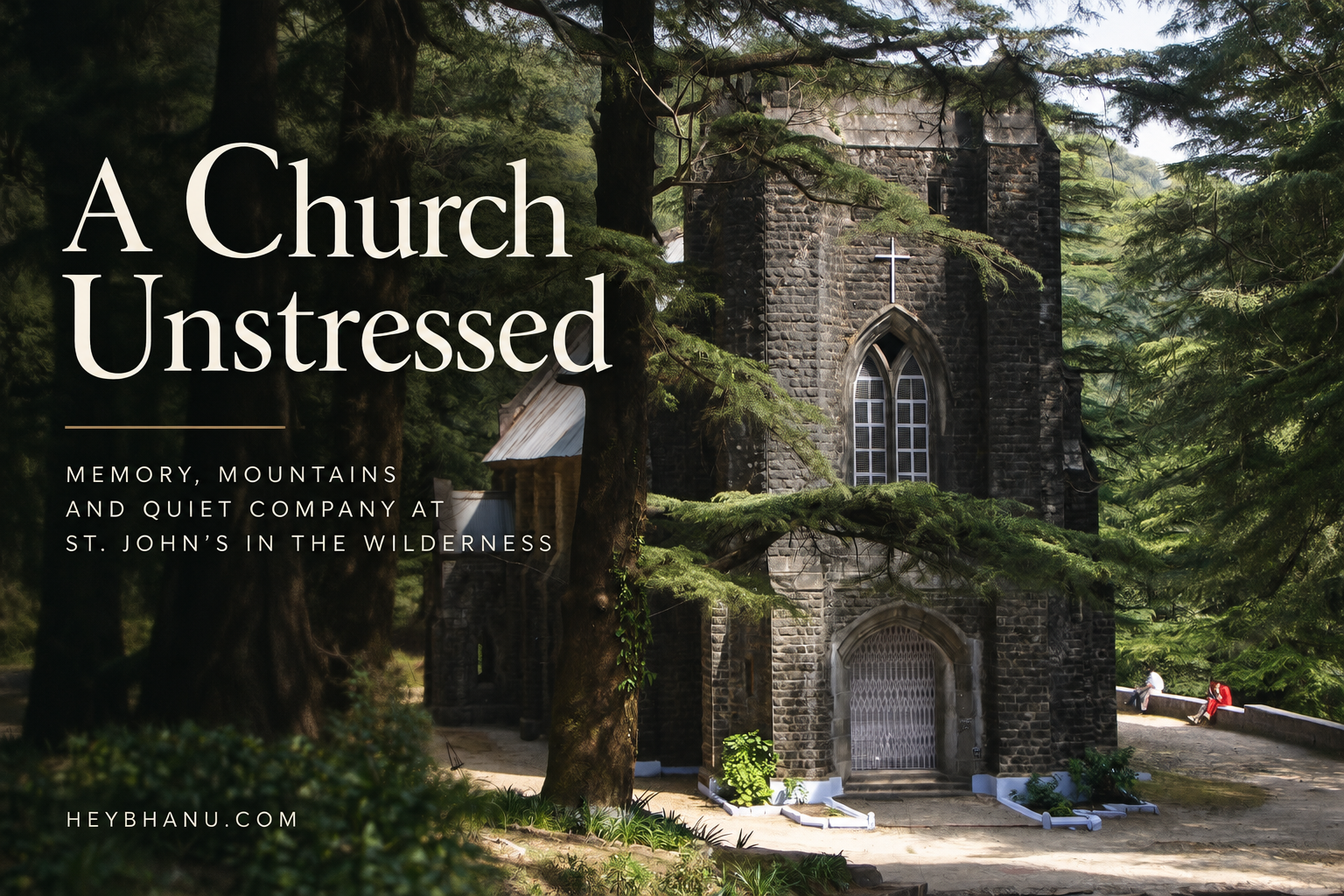
The road to St. John's in the Wilderness leaves the highway the way a good secret leaves a conversation - without announcing itself. No signboard worth trusting, just a give in the tar and a gap in the deodars where the noise of the town starts to fall away, a few decibels every ten steps, until by the time the church comes into view you've forgotten you were listening for anything. I first walked that road in the summer of 2001. I've walked it enough times since that I no longer remember which visit was which - only that they all end the same way, at a grey stone building holding perfectly still while the forest moves around it.
I was young enough then that the church's age felt less like history and more like reassurance. Adolescence, if I can be forgiven the retrospective clarity, is mostly a matter of things moving too fast to get a proper look at - your own face, your own opinions, the ground under a set of convictions you were certain, last week, were permanent. St. John's did not move. It had stood since 1852, through an earthquake in 1905 that left new stones of its own in the graveyard, through the slow withdrawal of the empire that built it, through a hundred and seventy-odd monsoons that should by rights have worn its granite down to something gentler. It hadn't worn down, only gone on being exactly the shape it started as - and there is a kind of company in that which needs no explaining to anyone who has ever felt like the only unstable object in an otherwise steady room.
So I camped there, more than once, tucking a bike and a bedroll into the tree line behind the graves and staying till first light. On paper this reads as a fairly morbid habit for a teenager. It never felt that way. The dead at St. John's are not anonymous in the way graveyards usually manage their occupants into anonymity - someone's widow paid for the stained glass, someone's regiment carried someone else's coffin further from home than either of them had ever planned to travel, and the names, cut into stone by hand, are still legible enough to read aloud if you're the sort of person who does that. Sleeping among people who had lived, by every account, urgently, far from the country that raised them, never struck me as keeping strange company. It struck me as honest company. Nobody in that ground wanted anything from me. They only wanted their names read once in a while, and that I could manage.
The larger comfort, though, wasn't the graves. It was the pastor.
He had time. That's the whole of it, and it deserves saying plainly rather than dressed up: he had time, in a way that has become close to a historical curiosity. A boy turns up on a motorcycle with road-dust on his face and no obvious reason to be there, and the pastor asks where he's ridden from, offers water before it's asked for twice, tells a joke that has clearly done service at that gate a hundred times before and has lost nothing for it. Nobody is waiting behind you. There's no queue turning his attention into a resource that has to be rationed out in fair shares. The hill villages ran, those years, more or less the way they had for decades - thin on event, generous with the little that happened. A visitor was still a person before he was anything else.
I don't think the church has changed. I want to be careful here, because it would be easy, and a little dishonest, to write a sentence like "the buses came and ruined it," as though the stone itself had been diminished. The stone is fine, the graves fine, weathering at exactly the rate they always meant to. What changed was the shape of the visiting itself - from an encounter between two people who had a spare minute for each other, into a stop on a route, photographed at speed and left behind before the light had finished whatever it was doing to the windows. I don't say this to scold anyone at that gate now with a phone out; I've done the same since I owned one. I say it because what made the church feel like company was never really its age. It was the unhurried attention it was able to receive and hand back. That's the part tourism is worst at protecting - worse than it is with forests, worse than it is with stone.
Which leaves the graves doing something they were never asked to do, and doing it, I think, rather well. They are the only company left at St. John's that hasn't learned to hurry. They don't perform a welcome and don't need one performed back. Lord Elgin, buried at the rear under a memorial his widow built larger than the occasion strictly required, has had a hundred and sixty-odd years to get used to strangers standing over him and has never once seemed impatient about it. I still go back, less often than I'd like, and I still find that the dead at St. John's are better at being present with a person than most of the living manage on a good day. They ask nothing and keep no schedule. They are, in the oldest and least sentimental sense of the word, unstressed - and for the twenty minutes it takes to walk that ground, so, for once, am I.