The Second Hunger

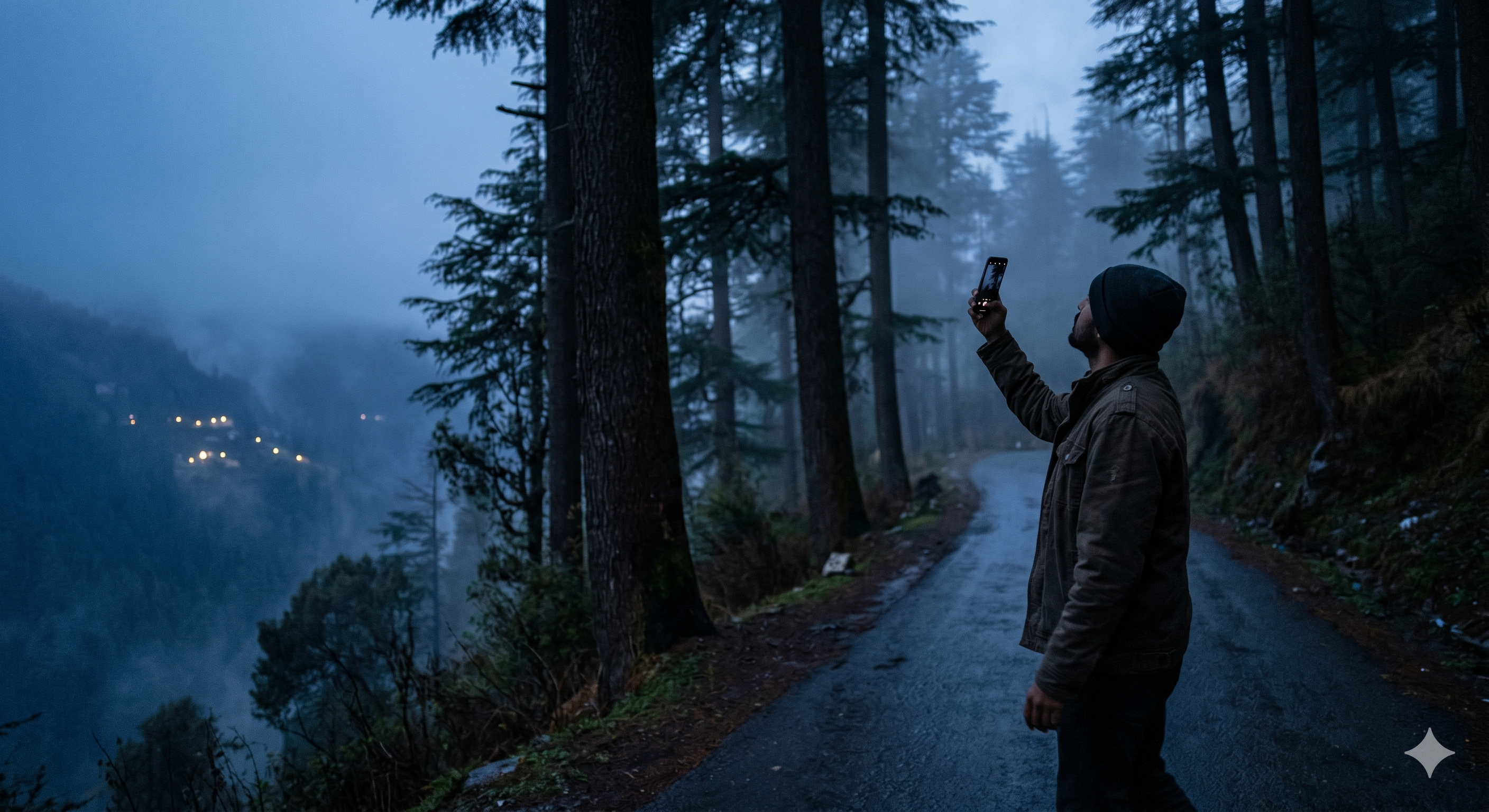
There is a road above the town that I take sometimes before the light has fully decided what kind of morning it wants to be. The deodars on either side are still dark at that hour, their shapes more suggested than visible. The valley below has not yet filled with sound. It lasts perhaps twenty minutes — that particular quality of early morning where the world is still uncertain of itself, and so, briefly, are you.
On one of those mornings I found myself reaching for my phone before I had fully registered what I was doing. The trees were doing something specific with the mist. I wanted to capture it. And in the half-second before I unlocked the screen, I noticed: I was not thinking about capturing it for myself. I was already composing the caption.
This is a small thing. It is also, I think, a complete diagnosis.
Somewhere in the last fifteen years, two different hungers got tangled together and began passing for one.
The first is the simple, bodily pleasure of experience — the physical fact of a cold morning, the particular quality of light on deodar bark, the way a valley looks before it has been asked to perform being a valley. The second is the need to be witnessed in that experience — to have it confirmed, annotated, shared, received. One is about taking something in. The other is about sending something out. For most of human history, the world's own slowness kept them apart: you went somewhere, you saw something, you came home, and perhaps much later — at a dinner, in a letter, in a photograph developed at some effort and expense — you described what you had seen. The doing and the telling were divided by time. That gap was not inconvenient. It was protective.
The phone closed it. Not dramatically, not all at once, but with the particular efficiency of something that makes itself indispensable before you've noticed you've accepted it. Now the doing and the telling can happen in the same second. And because they can, they increasingly must. The experience is not quite complete until it has been dispatched.
What I noticed that morning was that once you've started thinking about the caption, you're no longer really looking at the trees.
You're looking for what about the trees will be legible to someone who isn't here. You're editing in real time, selecting angles and framings and words that will translate the moment into something portable and receivable. This is a different activity from watching mist move through branches. It requires a different quality of attention — outward and anticipatory. Already in the future tense. The thing itself, the actual visual fact of those trees at that hour, starts to feel like raw material for something else.
And what the raw material produces — the photograph, the caption, the post — doesn't deliver the thing you were after. It can't. It was always a translation. The original feeling, the one that made you reach for the phone in the first place, doesn't come back when you check the notifications. It was there, in the trees, and you left it to go compose.
I've watched this happen to things I love. Not just passing moments but sustained pleasures — cycling, reading. At some point each of these acquired a second life on a screen. Routes became routes worth recording. Books became books worth being seen reading. Even solitude — which is by definition the thing you do alone — became a style of solitude, a particular aesthetic of aloneness that might, in theory, be shared.
I am not certain this always corrupts the thing. Sometimes the documentation genuinely is secondary, merely incidental. But I have become suspicious of that claim in myself, because I've noticed how quickly enjoyment that goes unshared starts to feel slightly incomplete. As if the experience was real but the record of it is what made it count. As if the pleasure needs a witness to fully become what it was.
That is the confusion I mean. Not the sharing itself, which is ordinary and human and often lovely. The confusion of needing the share for the enjoyment to feel real. And the witness — whoever swipes past in two seconds on a morning they're having in a city you've never been to — cannot give you what you actually needed, which was to have been there, fully, when the trees were doing that thing with the mist.
I put the phone back in my pocket. The trees continued doing what they were doing without my assistance.
I stood there for a while, not composing anything. The mist moved through the branches with no concern for legibility. The valley eventually found its sound. By the time I started walking again, I could not have told you exactly what I'd seen — not in any form that would transmit well. It had been replaced by something less precise and more complete.
I have since written this down, of course. It is on a website.
The phone is still in my pocket on those mornings. The impulse still arrives. But I've started treating it as information: when the instinct to document arrives faster than the instinct to look, that gap tells you something about which hunger is driving.