The Grade Doesn't Lie

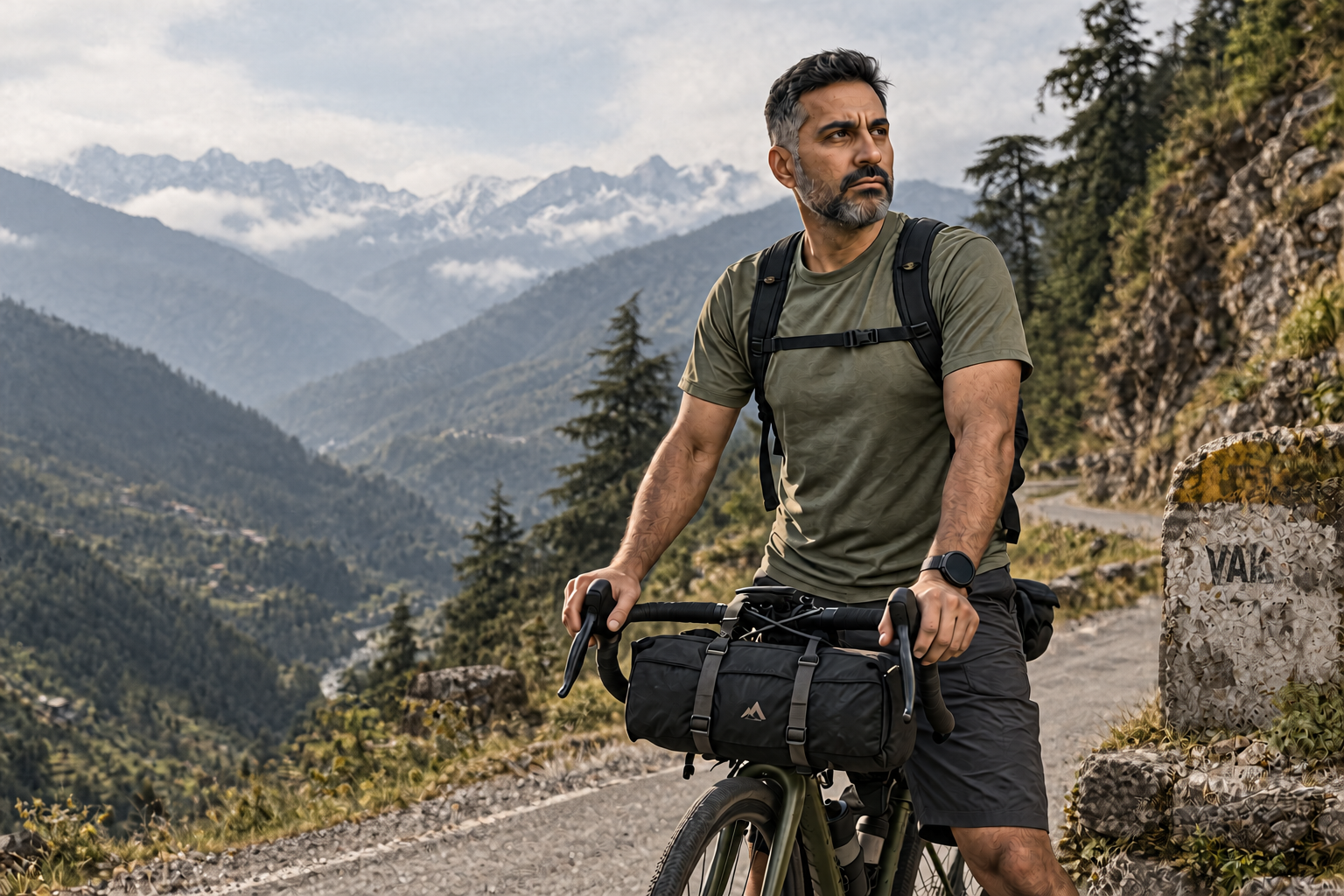
People ask, sooner or later, why I do these climbs on a bicycle when there is a perfectly good motorcycle in the shed and a jeep road that covers the same distance in a third of the time. I used to answer with the honest but slightly useless line:
the freedom of it, the plain beauty of it, is too good to pass up.
It's true, and it explains nothing, the way most honest answers to "why" explain nothing. The real answer took longer to find, and it turns out to hinge on a number.
Eleven per cent is a different animal from nine per cent. On a motorcycle these two figures might as well be the same fact, absorbed by a twist of the wrist and forgotten by the top of the climb. On a bicycle they are not the same fact. Nine per cent is a grade you can hold a thought through, breathe evenly on, notice the light doing something interesting to the ridge on your left. Eleven per cent removes the thought, then the breath, then eventually the ridge, and leaves you alone with your own legs and a small, repetitive argument you are having with them. The gap between those two numbers, a gap an engine erases without comment, is exactly the part of the mountain I go up there to feel.
I don't think this is really about fitness, or suffering for its own sake, though I understand why it looks that way to anyone standing at the bottom of the hill. It's about what the bicycle refuses to let me get away with. In a car or on a motorcycle, the work of the climb gets done by something other than you, and so the climb becomes, in a small but real way, borrowed: on loan from an engine, returned at the next petrol pump. A bicycle won't extend that loan. Every metre of altitude gained on these roads is a metre I am personally, individually responsible for, along with the pace at which I gain it, the place I'll sleep once I've gained enough of it, the food I'll need to gain any more tomorrow. There is no version of this arrangement in which something else quietly absorbs part of the bill.
Described like that, this full authorship over a single day sounds faintly heroic, and I want to resist that, because most of what it actually produces is not heroism but arithmetic. How many kilometres before the next water, how much daylight before the next village, whether the legs that survived the nine per cent section have anything left for the eleven. It is a more exacting kind of attention than the one you get through a windscreen. The Himalaya doesn't get smaller because you're moving through it slowly and under your own power. If anything it gets more exactly itself, every incline a fact you personally negotiate rather than a statistic your engine has already settled on your behalf.
There is also the matter of what you leave behind, or don't. These ranges are fragile in ways that are well documented by now, and a bicycle asks almost nothing of that fragility beyond the width of its tyres. No fuel spilled at a mountain stream, no exhaust laid into air a village further up will still be breathing tomorrow. This isn't a claim to virtue (I'm under no illusion that riding a bicycle up a pass makes me a steward of anything); it's closer to a house rule I've set for myself in a place I did not grow up in and have no ancestral claim to move through carelessly. Tread lightly is easy to say. A bicycle is simply one of the few ways I know to make it harder to avoid.
It is, I'll admit, a perverse kind of pleasure: choosing the version of the climb that costs the most to notice the most. But I've stopped apologising for that particular perversity. The road doesn't lie to me on a bicycle, and increasingly that feels like the rarer commodity in these hills, rarer even than the quiet.